|
Contents
Defining Ownership
The Data
The Incentive Effect
The Culture Effect
Management Implications
|
Research over the last 25 years is clear: employee ownership can motivate employees and
improve company performance, but only under certain conditions. The challenge
is to determine what those conditions are as accurately as possible. If
employee motivation is part of the answer, then one approach to this challenge
is through organizational psychology. The psychological perspective assumes
that the way people interpret ownership has a more direct impact
on company performance than legal structures or vision statements do. Leaders
therefore need reliable information about what ownership means to employees.
Over the past six years we have built a database on
ownership interpretations, as well as their attitudinal and behavioral effects,
using the Ownership Culture Survey™, or OCS.
This Report shares OCS data suggesting that the motivational power of ownership depends both on its
effectiveness as a financial incentive and on a deeper “culture effect.” After
reviewing the data, we propose five ways leaders can maximize the benefit their
companies attain from employee-ownership.
No one would deny that employee
ownership is about sharing the financial benefits of company success. Many
leaders believe that in the minds of employees it all comes down to cash,
either current or deferred. Our data indicates this is not the case. The power
of ownership seems to arise from harnessing both the financial and the
non-financial aspects of employee ownership. The data summarized here suggests
that, at its most effective, ownership gives employees not just a financial
reason to perform but a reason to belong.
Defining Ownership
Many company leaders appreciate
that a shared definition of ownership is needed if employee ownership is to
make a positive behavioral difference. They frequently attempt, either
consciously or by default, to promote a definition of ownership based on the
legal documents which state the parameters of the company’s ownership plan.
Unfortunately, the word
“ownership” has a myriad of meanings in the minds of employees-and the plan
documents are only one input among many. One study of the psychology of ownership
concludes: “culturally and behaviorally grounded conceptions of ownership may
not coincide with explicitly legalistic conceptions.”[1] It is not the legal definitions but the
“living definitions” of ownership that affect employee perceptions of the plan,
of the company, and of their own roles. Since these perceptions are the raw
material of group behavior, company leaders must work with and, where
necessary, challenge employee interpretations of ownership.
Varied and contradictory ownership
interpretations are reflected in responses to the Ownership Culture Survey™ (or
OCS), a survey-based approach to measuring the psychology of ownership. For
example, the OCS asks employees what first comes to mind when they think of
employee ownership. A sampling of the responses include: “investment,”
“incentive,” “teamwork,” “bogus,” “equality,” “a good benefit,” “employee
involvement,” and “what is it?”
In other words, the primary
association with ownership can be any one of a vast array of meanings:
participation in decision making, a benefit plan, camaraderie, short-term
financial payoff, long-term financial payoff, a gimmick, a chance for
egalitarianism, and an unknown. The potential for disparate opinions is
greatest in large companies with multiple locations and diverse work forces,
but even in small companies conflicting interpretations of employee ownership
can be substantial. The responses quoted in the paragraph above, in fact, are
drawn from one of the smallest companies to take the OCS, with fewer than 50 employees.
Based on our work with employee
ownership companies over the last 14 years, we have identified five major
aspects of ownership-most people in the United States are likely to define
employee ownership of a company using some combination of the following five
meanings:
- Financial Payoff: some people see ownership as a financial benefit-as owners, they expect at some point to receive cash value.
- Participation: some people want to be included on the decisions that affect their day-to-day work; they want to have a say over the issues that affect their working conditions.
- Influence: some people want to have a part in broader, company-wide decisions. They want a degree of influence over strategic issues.
- Community: some people want to feel a bond with their fellow owners; they want to feel that the whole company is “in this together.”
- Fairness: some people primarily want to be treated fairly by the company; they want sensible rules and they do not want “special treatment” for specific individuals.
The Data
The findings reported here come
from 4,110 employees at 17 employee-ownership companies which have completed
the Ownership Culture Survey™.
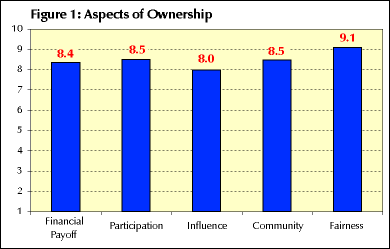
One part of the OCS asks respondents to rate the
importance of each of the five aspects of ownership listed above. Respondents
give each of these aspects a score from one to ten, where ten means that aspect
is very important to them, and one means it is not at all important. Not
surprisingly, respondents report that all five aspects are important-the
average scores for all items are above 7.0 at a majority of OCS companies.
The most interesting and
consistent feature of people’s answers is that fairness is clearly rated as the
most important, as seen in figure 1.
In fact, no matter how we analyze
the data, people overwhelmingly rank fairness as most important. That’s true
for managers and non-managers, new employees and long-term employees, men and
women, young and old, high paid and lower paid. It even holds for people we
identified as cynics.
Figure 1 also indicates that
influence is consistently rated as the least important of the five aspects. It
is less important than a related concept: participation. In other words,
employees seem to place more value on having input in decisions that affect
their daily work experience (participation) than on global, “strategic”
decisions (influence).
One surprising pattern emerges
over and over in the data: middle managers and supervisors tend to rate these
meanings of ownership as less important than other employees do, including senior
managers.[2] For most
people, middle managers are the “face” of the company, and an ownership culture
will be almost impossible without their active support.
The Incentive Effect
Many companies implicitly use a
model that assumes that the financial aspect of ownership is the most
important. They assume that ownership is, primarily, a incentive that aligns
employees’ interests with company interests. To a great extent this is true,
and it is this financial alignment of interests which we term “the incentive
effect.”
The incentive effect reflects the
capacity of employee ownership to give employees a monetary reason to perform
their jobs well. It plays an essential role in motivating employees because it
gives each employee an individual profit motive to promote company success and
its stock value.
The incentive effect is also
crucial for a second reason. Previous research indicates that employees will
not feel psychological ownership until they trust that they will share in the
financial benefits of ownership[3]--i.e.,
until they feel the incentive effect.
Some companies do not expect
employees to feel like owners. They may want nothing more than a new way to
motivate employees, and they expect this motivation to follow automatically
from the stock plan. In practice, however, the existence of equity-based
incentives does not necessarily translate into changed motivation. Many
ownership plans stumble in the face of distrust and cynicism.[4]
The incentive effect only exists
under the right conditions, and companies are wise to invest sufficient
resources to educate the work force and to communicate the details of their
stock plan.
The incentive effect is likely to
be strongest in companies that offer short- or medium-term rewards, such as
stock-options, gainsharing, or profit sharing. In some cases, however, these
incentives can actually be too powerful-the short-term incentive
can overwhelm concern for the long-term viability of the company, resulting in
a “casino mentality” where employees’ primary loyalty is to their own
short-term financial well-being. The most powerful formula for success seems to
involve a combination of short-term incentives, long-term incentives (such as
an ESOP) and a culture which involves people beyond the purely financial level.
The incentive effect can be
created by non-equity-based bonus or retirement plans which mimic the cash
flows of equity ownership. However, one final point to draw from figure 1 is
that the financial aspect of ownership is not the top priority
identified by most respondents. The other aspects of ownership, which we call
“the culture effect,” are explored next.
The Culture Effect
While the incentive effect can be
simulated by non-ownership compensation tools, the culture effect is
unique to employee-ownership. It is a deep connection to the company, a
relationship based on more than money. Ownership can give employees a reason to
belong to the company. The culture effect is the result of psychological
ownership, and only exists in companies which actively nurture a sense of
ownership in the work force.
We have suggested elsewhere that
an ownership culture has multiple dimensions, including access to information,
a degree of input into decisions, a sense of organizational fairness, and an
entrepreneurial outlook. Each of these dimensions entails a balance between the
rights granted to employees and the responsibilities they accept. More detail
about ownership culture is available in other publications [5]
but here we focus on one piece of
ownership culture: fairness, which the data in figure 1 indicates is of central
importance in how employees conceptualize ownership.
Figure 2 supports the same
conclusion. There is a strong negative relationship between cynicism and
perceived fairness. (Here fairness is measured by an OCS item which asks to
what extent respondents agree that “overall, this company is fair to its
employees.” [6]
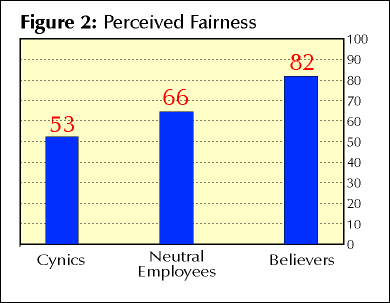
The differences among these groups
are based on data from over 2,500 employee owners and is highly statistically
significant. This relationship is correlation, not causal, but it implies that
companies interested in the benefits of the culture effect would be well
advised to focus on fairness.
Why should companies bother with
the culture effect? The incentive effect is necessary, but the real power of employee
ownership results from the culture effect. Studies indicate that by itself
ownership has an uncertain impact on company performance. An ethic of
involvement in the company is needed to change behaviors. One researcher wrote
that “the combination of employee ownership and significant participation makes
it possible for employee ownership companies, on the average, to have an
advantage unavailable to their competitors.” [7]
This conclusion is also consistent with the data reported here about the
secondary importance of the financial aspect of ownership.
Management Implications
The data suggests five steps
leaders may wish to consider in their own companies.
Focus on fairness.
Companies should make an explicit
effort to seek out and address the fairness concerns of the work force.
Consider reacting to concerns either through policy change or communicating the
principles behind policies which are perceived as unfair. Pay special attention
to perceived special treatment and favoritism. In general, fairness is
likely to be an effective theme in company communications. Companies should
consider explicitly using ideas of fairness in their presentation of the
rationale for their ownership plan.
Support middle managers and supervisors.
Middle level managers often need
substantial support before they change their perceptions of ownership.
Companies which have not yet started their transition to employee ownership may
want to involve supervisors and middle-managers in the design process in order
to ensure that they support the final product.
Plan employee participation.
Especially in the early stages of
employee-ownership, companies are wise to focus on involving people in local
decisions (at the level of the department, work group, or even the individual
work site) rather than more company-wide concerns. Involvement at the strategic
“global” level often becomes important over time, and it does have powerful
symbolic effect, but it is the day-to-day issues which are likely to have the
greatest immediate effect on most people’s attitudes.
Link company programs to ownership.
Ownership can be a “glue” to tie
various company programs (bonuses, safety initiatives, work redesign, hiring
procedures, benefit packages, and communications programs) together into a
coherent whole.
Ask people what they want from ownership.
Find a systematic and
psychologically safe way for people to express what ownership means to them.
This will allow you to tailor various features of the ownership plan to the
particular needs of your work force and to track changes over time. If you make
changes based on this input, tell people that the change was made because they
said they wanted it. Linking the change to their input can be just as important
as the change itself.
The Ownership Culture Reports are a series of working papers
published by Ownership Associates, Inc. Other issues available on the web include:
Trust and Ownership: Trust in Managers and Trust in Ownership, No. 1, May 8, 1998.
Participation: Decision Making and Employee Ownership, No. 2, September 17, 1998.
Ownership Cynics, No. 3, July 9, 1999.
Visit the Ownership Culture Report main page for more
information or to sign up for a free subscription.
Endnotes

