This document contains excerpts from The Ownership Incentive,
a training module available from Ownership Associates.
Contact us for more information about the contents, uses, and pricing of the full training.
Introduction
For many companies, a primary goal for the employee-ownership plan is to align the interests of
everyone at the company. These companies want ownership to serve as an incentive system to
bring the company to a new level of performance.
The most common obstacle to the success of the ownership incentive is failure to properly
educate the work force. For ownership to be an effective incentive it is not enough that
employees actually will share in the company's success-they must also believe that they
will. This belief is only possible where employees understand how the ownership plan works.
Our Ownership Facts curriculum explains how various
ownership plans (including ESOPs, stock options, stock purchase plans, direct ownership, and
partnerships) work in clear and easily accessible terms. This training often includes the
Ownership Incentive framework, which helps non-management employees understand
how employee ownership changes their relationship to the company.
The following pages illustrate some of the major ideas in the Ownership Incentive
presentation. We also include some excerpts from our planner/trainer notebook.
The Standard Employment Deal
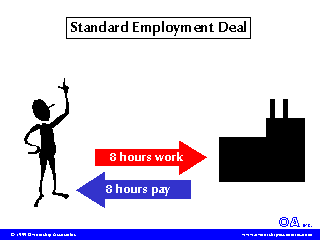 At most American companies, the employment deal is simple. Everyone understands the standard employment relationship described in the picture to the right. It is the one we all learned at our first job. "If I work eight hours for the company, the company will give me eight hours of pay." It implies that the employees' only responsibility is to show up and do their jobs.
In the standard employment deal employees are motivated to work just hard enough to keep their jobs. They satisfy basic job requirements and hope the company remains strong enough to keep them employed.
The standard employment deal does not motivate employees to share ideas and personal energy to find better ways to do their jobs.
The "New Deal"
The "New Deal" in employee-ownership companies adds a new element to the employment relationship.
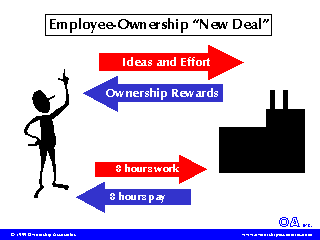 In most employee-ownership companies, the new deal is intended to inspire employees to share their
effort and ideas to make the company more successful. In exchange, the company shares with the
employees an ownership interest.
In most employee-ownership companies, the new deal is intended to inspire employees to share their
effort and ideas to make the company more successful. In exchange, the company shares with the
employees an ownership interest.
Employees do not become motivated to work differently until they understand and trust their new
relationship with the company. The picture to the left illustrates that new relationship. Employees
begin to act upon this new relationship when they understand how they personally affect
company performance and how they personally will profit if the
company succeeds.
In other words, the new deal works when employees believe that "If I make money for the company,
the company will make money for me." Although simple in theory, this concept includes several
important stages. The following sections explain the pieces of the new deal and demonstrate how
it can guide a company's planning.
Return on Effort
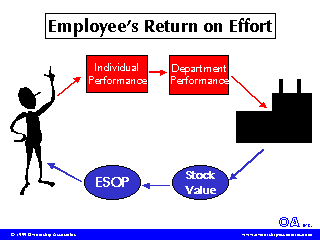
Employee ownership plans reward employees for improving company performance.
Through their ideas and effort, employees improve their individual performance,
the effectiveness of their departments, and the overall profitability of the company.
As a result, the company increases in value and the employees' accounts are worth
more. Just like investors expect a "return on investment," employee-owners can earn
a "return on effort." When employees are motivated by personal profit, as a group
they can have a major impact on the success of the company.
Means, Motive and Opportunity
The simple detective-novel formula of means, motive and opportunity is a simple way to
understand incentive systems. An incentive system will work when it gives employees the
means to improve company performance, the motive
to care about company performance, and the opportunity to do
something about company performance.
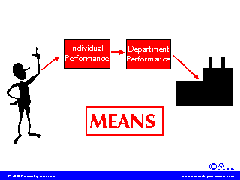 The top half of the ownership incentive is the means. To improve company performance, employees must know how to measure personal success and company success. They need to understand the criteria for performance and how their job fits into the "big picture" of company success. Through improvements in their personal performance, working with their colleagues and sharing their ideas to improve operations and quality, individual employees can affect company performance.
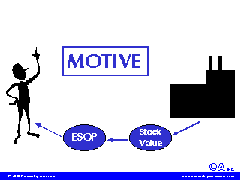 The bottom half of the ownership incentive is the employees' motive. It is how and why employees become motivated to make the company more successful. They need to understand how company performance affects the stock price, how stock price affects the value of their ownership interest, and how they will receive the value of their ownership accounts. If employees do not fully understand just one of these links, they are less likely to be motivated to improve company performance.
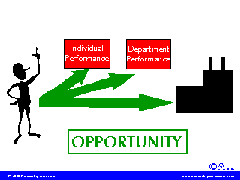 Employees have the opportunity to affect their individual performance through their daily job. Many employee-owned companies have found that giving employees a reasonable amount of input into departmental and company-wide operations can be a competitive advantage. These issues are covered in the Ownership Associates curriculum Frontiers and Boundaries: Managing Ownership Expectations.
Return on Ownership
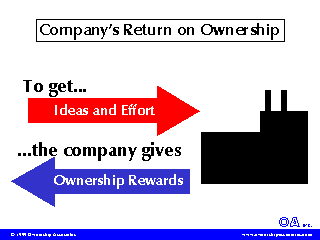 From the employees' perspective, the "new deal" means that they earn a return on their
efforts to make the company successful. From the company perspective, shared ownership
is a good deal if it increases workforce enthusiasm, effort and creativity. In other words, the
company is looking for a "return on ownership." In successful employee-ownership companies,
the "new deal" works because everybody benefits.
From the employees' perspective, the "new deal" means that they earn a return on their
efforts to make the company successful. From the company perspective, shared ownership
is a good deal if it increases workforce enthusiasm, effort and creativity. In other words, the
company is looking for a "return on ownership." In successful employee-ownership companies,
the "new deal" works because everybody benefits.
For the employee-ownership plan to gain employees' trust, people must understand why the
company is willing to make this ownership deal. If they understand how the company benefits,
they are more likely to believe that the ownership plan is fair and not suspect that someone is
taking advantage of them.
Adopting a new-deal approach is a challenge in many American employee-owned companies
because people have grown accustomed to the standard employment deal. The new deal may
take some getting used to, but it is a central strategy of successful businesses around the world.
Excepts from the Planner/Trainer Notebook
The Ownership Incentive: Goals
One of the purposes of the Ownership Incentive curriculum is to help
employees understand how they share in company success. Our clients have found that
employees are unlikely to believe that the ownership plan is in their interest until they
understand how it is in company's interest as well.
The Ownership Incentive structure can provide consistency to
company training and communications programs. For example, training programs
should address the Return on Effort issues in reverse order.
Employees first need to understand how the ownership plan will provide them with a cash benefit.
Until they understand the payout mechanism, the have no reason to care about the
stock price. Until they understand the stock price, they will not care about the success
of the company, and, ultimately, their own or their colleagues' performance.
Applications
The framework presented in this booklet can be used in a variety of ways.
Our clients have found the Ownership Incentive to be an effective starting point for a
training program explaining the basics of their ownership plan. (In the case of an ESOP,
the basics include participation, contribution, allocation, vesting, diversification and
distribution.) For some, this has proven to be an effective stand-alone program.
The Ownership Incentive can also contribute to strategic planning.
Combined with other planning tools, this framework can help structure long-term
employee-involvement programs, educational goals, information-sharing processes,
and compensation systems.
Other clients use the Ownership Incentive as part of a broader
culture-change effort, either on the own or with support from Ownership Associates.

